How to write your performance review self-evaluation with AI
Turn a year of messy notes into a specific, honest self-evaluation: copy-paste AI prompts for your brag list, impact statements, areas to improve, next year's goals and the review meeting.
In this guide (8 steps)
- Collect your evidence (the 20-minute brag list)
- Match your evidence to the review form
- Turn tasks into impact statements
- Write the hard parts honestly (missed goals and areas to improve)
- Set next year's goals
- Make it sound like you, then cut to fit
- Prepare for the review conversation
- For managers: writing reviews for your team with AI
An 18-page printable PDF: a self-evaluation worksheet, a year-long wins tracker, a 2027 goal-setting sheet, an optional raise or scope-ask planner, and 25 copy-paste AI prompts that tell the AI not to invent facts. One-time $5, 30-day refund.
Get the year-end kit for $5 →The self-evaluation is the part of a performance review most people put off until the night before. Then they write "worked hard on many projects" and undersell a whole year. AI can't remember your year for you. It is good at the part that's actually hard: turning a messy pile of notes into clear, specific statements that match the questions on your form, in your own voice.
This guide works for annual and year-end reviews, mid-year check-ins and promotion packets. It takes about an hour spread over two sittings. The rule for every step: the AI only rewrites what you give it. It must not invent results, numbers or praise.
Collect your evidence (the 20-minute brag list)
Scroll back through the year before you write a word: your calendar, sent email, finished tickets or tasks, project docs, chat threads where someone thanked you, and last year's goals. Jot one rough line per thing. Don't polish yet.
Here are my rough notes from the past year at work, in no particular order:
[paste bullet notes: projects, tasks, fixes, people you helped, things you learned, thank-you messages, numbers you're sure of]
My role: [job title, team, what I'm mainly responsible for].
Group these into 4–6 themes (for example: main projects, improvements, helping others, learning).
Under each theme, list the items as short accomplishment lines.
Do NOT add any facts, numbers or outcomes I didn't write. Where a result is missing, write [result?] so I can fill it in.
Then ask me up to 5 questions about the items where the impact isn't clear yet.
Answer its questions in plain words ("the report used to take two days, now it's one afternoon"). Those answers are usually the strongest lines in the final review.
Match your evidence to the review form
Most forms ask the same few things in different words: main accomplishments, goals you met or missed, strengths, areas to improve, and goals for next year. Some rate you on company values or competencies. Paste the actual questions so the answers fit what your manager will read.
These are the questions on my self-evaluation form (with any character limits):
[paste each question and limit]
Last year's goals for me were: [paste, or "none written down"].
Using only my themed list below, put each item under the question it answers best. If one item fits several questions, pick the best one.
Mark any question that has no evidence yet.
[paste the list from Step 1]Turn tasks into impact statements
"Managed the newsletter" is a task. "Took over the weekly newsletter and cut the time to send it from about a day to about two hours by building a template" is an impact statement: what you did, how, and what changed. Real numbers help, but only ones you can back up. "Fewer customer complaints about X, per our support lead" beats a made-up percentage.
Rewrite each accomplishment below as 1–2 sentences: what I did, how I did it, and what changed because of it (for the team, customers or the business).
Rules: first person, plain words, no buzzwords ("synergy", "leveraged", "spearheaded"), no exaggeration.
Use only facts and numbers I gave you. If an impact isn't stated, end the line with [impact?] instead of guessing.
Keep each under [40] words.
[paste the items under one question]
Illustrative before/after (made-up example, not a template to copy):
- Before: "Helped with onboarding."
- After: "Wrote a one-page checklist for new hires on our team and walked the 3 people who joined this year through it, so they could take shifts on their own in their first week instead of their third."
Write the hard parts honestly (missed goals and areas to improve)
Managers notice a self-review with no weak spots. A short, specific, honest answer reads as maturity, not weakness. Name the gap, say what you learned, and say what you're doing about it.
Help me write the "areas for improvement" and "goals I didn't fully meet" sections.
What actually happened: [e.g. the Q3 launch slipped 3 weeks; I said yes to too many requests; I avoided presenting].
Why, as honestly as I can say it: [notes].
What I've already changed or plan to change: [notes].
Write 2–3 short paragraphs that own the issue without blaming others or beating myself up, and end each with a concrete next step.
Don't make it sound worse or better than what I wrote.Set next year's goals
Good goals are specific enough that you and your manager will agree at the end of the year whether they happened. Tie them to what the team needs and to what you want to grow into, such as a promotion, a new skill or a bigger project.
Suggest 3–4 goals for my next review period.
My role and team priorities next year (as I understand them): [notes].
What I want to grow into: [e.g. lead a project, get better at data, move toward a senior role].
For each goal give: the goal in one sentence, how we'd know it's done, a rough timeline, and what support I'd ask my manager for.
Keep them realistic for someone who also has a full normal workload.Make it sound like you, then cut to fit
AI drafts drift toward the same polished, slightly salesy voice. Your manager knows how you write, so pull it back.
Here's a sample of how I normally write at work: [paste 2–3 of your own emails or messages].
Edit my self-evaluation below to match that voice: same sentence length, same level of formality.
Remove anything that sounds like marketing copy, any claims stronger than my notes support, and repeated points.
Then trim each answer to fit these limits: [question – character limit].
[paste draft]
Read it out loud once. If a sentence is something you'd be embarrassed to say to your manager's face, rewrite it. Count characters in your HR tool, not just in the chat, because some forms count spaces and line breaks differently.
Prepare for the review conversation
The written review sets up a conversation. Spend ten minutes getting ready for it, especially if you plan to ask about a raise, a title change or a different project.
I have my performance review with my manager on [date]. Here is my self-evaluation: [paste].
1) List the 3 points I most want my manager to remember, in one line each.
2) Predict 5 questions or pushbacks my manager might raise, and draft a short, calm answer for each using only my evidence.
3) Write 3 questions I should ask about expectations for next year and what "exceeds expectations" looks like on my team.
4) If I want to ask about [a raise / promotion / new responsibilities], write a 2-sentence opener I can say out loud.
If pay is on the table, our guide to negotiating a salary raise with AI walks through market data, the number to ask for and practice rounds.
For managers: writing reviews for your team with AI
The same rules apply, with one more: fairness. Base every line on specific examples you observed, and check your wording across the team. It's easy to call one person "assertive" and another "abrasive" for the same behavior. Don't paste employees' personal or confidential information into a public chatbot, and follow your HR team's rules on AI use.
I'm writing a performance review for a team member. My notes (examples I saw myself, with rough dates): [paste, using a role instead of a name].
Our rating scale and form questions: [paste].
Draft balanced feedback: specific strengths with examples, 1–2 growth areas with examples, and suggested goals.
Then review the draft for vague or loaded words (e.g. "abrasive", "not a team player", "emotional") and suggest specific, behavior-based wording instead.
Don't add anything that isn't in my notes.
💵 Next: ask for the raise
Market data, your number and practice rounds for the pay conversation.
A 35-page printable PDF (resume-bullet builder, job-posting decoder, cover-letter planner, interview story bank, offer comparison and negotiation planner), an application-tracker spreadsheet for Excel or Google Sheets, fill-in email templates and 40 copy-paste AI prompts that tell the AI to ask you for facts instead of inventing them. It will not get you hired by itself, and AI can be wrong, so check every fact. One-time $9, 30-day refund. Save $4: get both for $12 with the Career Bundle: AI Job Search Kit + 122-Prompt Pack, which adds our 122-prompt Everyday AI Prompt Pack ($7 on its own).
Get the job search kit for $9 →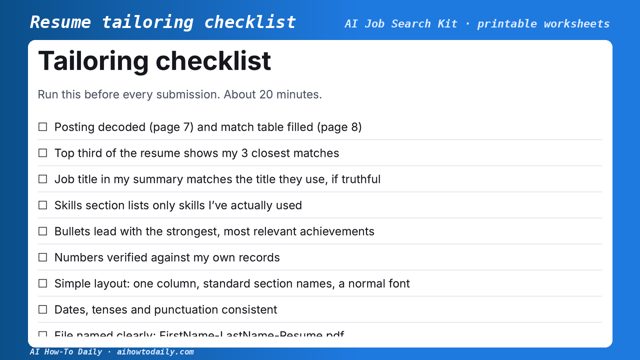
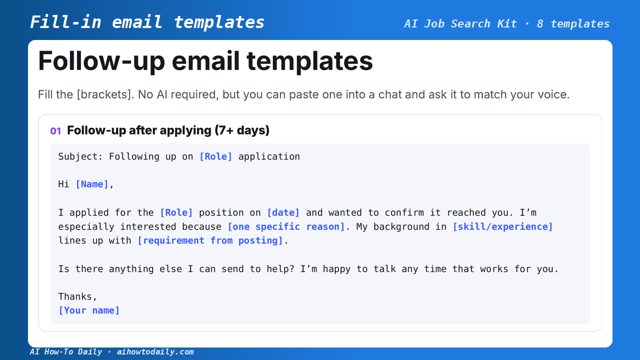
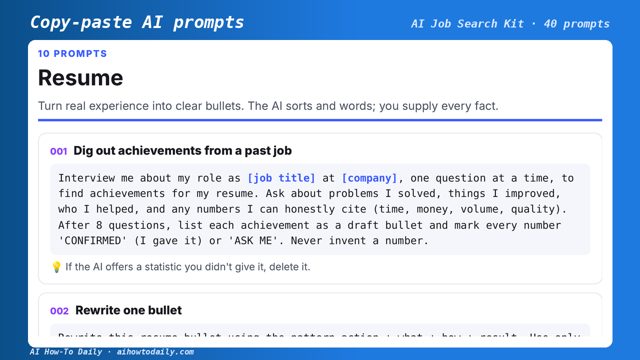
👀 Real pages from the PDF. Free 4-page sample (PDF, no email needed). The buy button opens Gumroad's secure checkout for “Career Bundle: AI Job Search Kit + 122-Prompt Pack” ($12); the download link arrives right after you pay.
Launch price: 40% off with code LAUNCH40 ($7.20, was $12) through Nov 30.
Frequently asked questions
Can I use ChatGPT to write my self-evaluation?
Yes, as an editor of your own notes: list what you actually did, then ask ChatGPT, Claude, Grok or Gemini to group it, rewrite it as impact statements and fit it to your form. Tell it not to add facts or numbers, and check your employer's AI policy before pasting anything confidential.
What should I write in a performance review self-evaluation?
Answer the questions on your form with specific evidence: your main accomplishments and what changed because of them, goals you met or missed, one or two honest areas to improve with what you're doing about them, and concrete goals for next year.
How do I write about weaknesses in a self-evaluation?
Name one or two specific gaps, say briefly why they happened without blaming others, and end each with a concrete step you've taken or will take. A short honest answer reads better than none at all or a disguised strength.
How long should a self-evaluation be?
Follow your form's limits. If there are none, a few short paragraphs or 3–6 bullet points per question is usually enough. Lead with your strongest, most specific examples and cut repeated points.
Is it OK for managers to use AI to write performance reviews?
It can help with structure and wording, but the content must come from examples you observed yourself. Follow your company's HR and AI rules, keep employees' confidential details out of public chatbots, and check the draft for vague or biased words.
Quick tips on this topic
⚡ Brag list before review season
Turn a year of rough notes into themed accomplishments without inventing anything.
⚡ Task to impact statement
Rewrite a task as what you did, how, and what changed.
🎁 Get all 159 copy-paste prompts free
Every prompt from our guides and tips on one page, for email, spreadsheets, meetings, automation and more. Fill in the brackets and paste.