How to write a condolence email with AI (subject lines and examples)
Write a short, sincere condolence email with ChatGPT, Claude, Gemini or Grok: when to email vs send a card, subject lines, workplace notes and a gentle follow-up — using only your real details.
Condolence and careful emails: 122 copy-paste prompts organized by task, offline PDF, ready to print or keep offline. One-time $7, 30-day refund.
Get the full pack for $7 →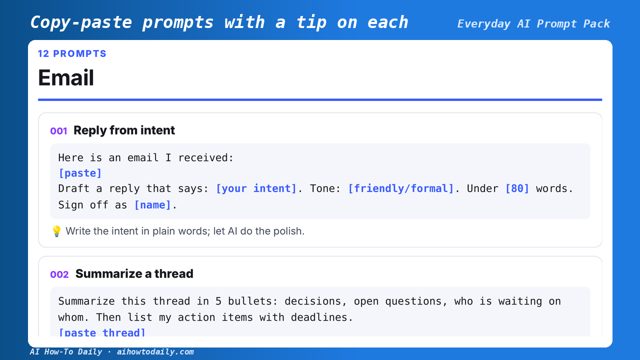
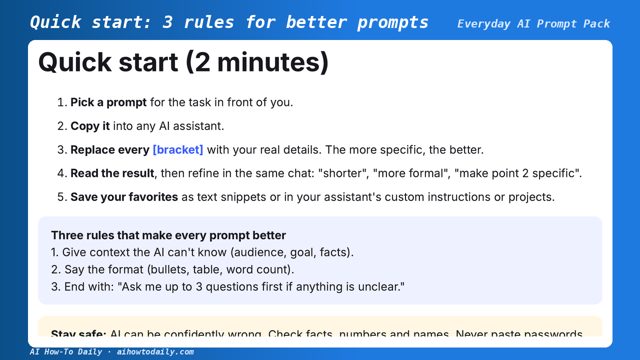
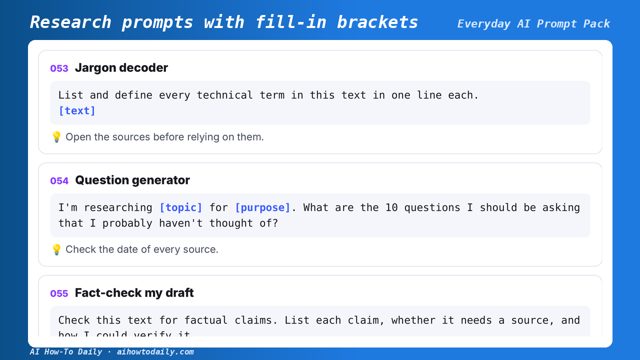
👀 Real pages from the PDF. Free 3-page sample (PDF, no email needed). The buy button opens Gumroad's secure checkout for “Everyday AI Prompt Pack: 122 Copy-Paste Prompts” ($7); the download link arrives right after you pay.
A sympathy card is usually a few handwritten sentences. A condolence email is for when you're farther away, writing from work, or need a subject line and a slightly longer note. The rule is the same: your relationship and one real detail; AI only helps with wording. Never invent a memory, a cause of death, or religious language the person didn't ask for.
Writing a short card instead? See what to write in a sympathy card. Speaking at a service? How to write a eulogy with AI in your own words.
Decide: email, card, or both
- Email when speed, distance or workplace norms matter (tell a team, reach someone overseas, follow up weeks later).
- Card when you can handwrite a few lines and mail or leave it — often feels more personal.
- Both is fine: a short email now, a card that arrives later.
Gather only what you need
Help me write a short condolence email.
Recipient: [name], my [coworker / friend / client / relative].
They lost: [relationship + name if I know it, e.g. their father, James].
How well I knew the person who died: [well / a little / never met].
One true detail I could mention: [memory, or "none"].
Tone: [plain / warm / formal workplace].
Religion: [none / include a short blessing they would welcome / unknown — keep secular].
Ask me up to 3 short questions if something important is missing. Then wait.
You don't need the cause of death or private medical details. Names, relationship and one memory are enough.
Subject lines that don't stumble
Suggest 6 subject lines for a condolence email to [name] about [their mother / father / partner / friend], from me as their [coworker/friend].
Rules: plain, respectful, no euphemisms that hide the news if they already know, no "hope you're doing well", under 8 words when possible.
Label which fit: (a) they already know (b) I might be breaking the news gently to a small work group.
If they already know, subjects like "Thinking of you" or "So sorry about [Name]" are enough. If you're informing a team, say so clearly and share only what the family is OK making public.
Draft three short emails
Write 3 condolence emails from what I told you, each 4–8 sentences:
1) Simple and warm
2) Includes my memory (or skips it if I said none)
3) Includes one specific offer of help I can keep
Also give a 2-sentence version for a group work email.
Plain words. No clichés ("everything happens for a reason", "they're in a better place"). No advice. Nothing I didn't tell you.
Pick the closest one, change words until it sounds like you, and send from your own account — not as a mass BCC unless it's a workplace announcement the family approved.
Workplace and group emails
- Ask HR or the person closest to the family what can be shared before you email a whole team.
- Keep group notes short; save personal memories for a private email or card.
- Offer concrete coverage ("I can take Thursday's standup") instead of "let me know if you need anything".
Rewrite this draft as a short workplace condolence email to our team about [colleague]'s loss.
Keep under 120 words. Share only: [facts I'm allowed to share]. Invite people to support privately, not in reply-all. Soft close.
Draft: [paste]Follow up weeks later
Grief lasts longer than the funeral week. A short check-in after 2–3 weeks is often welcome.
Write a short follow-up message (email or text) to [name] about 2–3 weeks after their [loss].
One or two sentences: still thinking of them, no pressure to reply, optional specific offer ([coffee / a meal / covering a shift]).
No "how are you holding up" if that feels heavy — give me a softer alternative too.
Need holiday wording for someone having a hard year? Christmas and holiday card messages. Sharper prompts in general: the 5-part formula.
💌 Prefer a handwritten card? Short sympathy messages
Two to four sincere sentences, what to avoid, and thank-you notes after a funeral.
🕯️ Writing remarks for the service?
Gather memories, draft gently, and keep it in your own words.
🦃 Remembering someone at Thanksgiving: one or two gentle lines
Under-a-minute toast drafts, a grace for a mixed table, remembering someone missing, and a kids' gratitude bowl.
Condolence and careful emails: 122 copy-paste prompts organized by task, offline PDF, ready to print or keep offline. One-time $7, 30-day refund.
Get the full pack for $7 →Frequently asked questions
What's the difference between a condolence email and a sympathy card?
A sympathy card is usually a few handwritten sentences you mail or leave. A condolence email is better for speed, distance or work, and needs a clear subject line. The tone should stay short and sincere either way. See both this guide and the sympathy card guide.
What should the subject line of a condolence email be?
Keep it plain: "Thinking of you", "So sorry about [Name]", or for a work announcement something clear the family has approved. Avoid cheerful openers like "Hope you're well".
Is it okay to send a condolence email instead of a card?
Yes. Many people appreciate a prompt, sincere email — especially coworkers and friends who live far away. A card can still follow. What matters is that the words are yours.
How do I write a condolence email to a coworker or team?
Keep it short, share only what the family or HR says is OK, avoid reply-all pile-ons, and offer specific help (covering work) rather than vague offers. Use the workplace rewrite prompt in this guide.
Can I use ChatGPT to write a condolence email?
Yes, as a wording helper. Give it your relationship and one real detail, ban clichés and invented facts, then edit so it sounds like you. Don't paste private medical details.
When should I follow up after a condolence email?
A short note about 2–3 weeks later is often kind, when support has dropped off. One or two sentences is enough; don't demand a reply.
How do I sign off a condolence email?
Keep it simple: "With sympathy", "Thinking of you", "With love" (for family and close friends), or "With deepest sympathy" for more formal notes, then your name. Skip "Best" or "Cheers".
Should I tell them they don't need to reply?
Yes, it's kind. A line like "No need to reply — I just wanted you to know I'm thinking of you" takes pressure off someone who's getting a lot of messages.
How do I write a condolence email to a client or customer?
Two to four sentences: say you're sorry for their loss, offer flexibility on anything work-related ("Please don't worry about Friday's deadline"), and close warmly. Don't mix in sales or project updates; send those separately later.
What should I avoid saying in a condolence email?
Avoid explaining the loss ("everything happens for a reason"), comparing it to your own, asking for details about how they died, or giving advice. If unsure, say less: "I'm so sorry. I'm thinking of you."
Quick tips on this topic
⚡ Subject line first
For condolence email, lock a plain subject before you draft the body — no "hope you're well".
⚡ Email vs card
Ask AI when email, a card, or both fits — then keep the same short sincere tone either way.
⚡ No reply-all grief
Workplace notes stay short; save personal memories for a private message.
🎁 Get all 159 copy-paste prompts free
Every prompt from our guides and tips on one page, for email, spreadsheets, meetings, automation and more. Fill in the brackets and paste.