How to use AI to choose a charity and check it's legit before GivingTuesday
GivingTuesday is Tue, Dec 1, 2026. Use ChatGPT, Claude or Gemini to plan your giving and spot scam appeals, then verify charities with the IRS search and independent reports. Includes 2026 tax rules.
Year-end letters, budgets and careful emails: 122 copy-paste prompts organized by task, ready to print or keep offline. One-time $7, 30-day refund.
Get the full pack for $7 →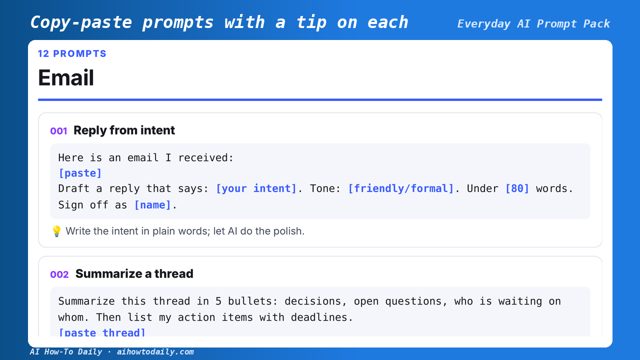
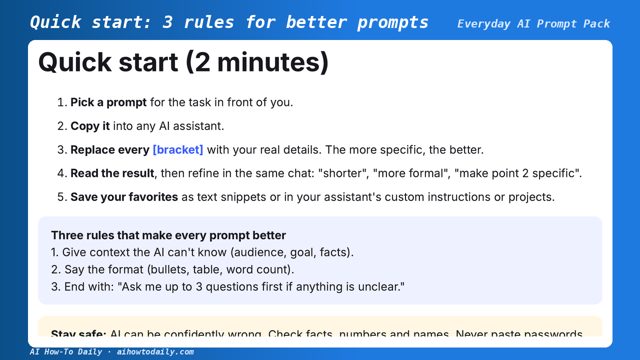
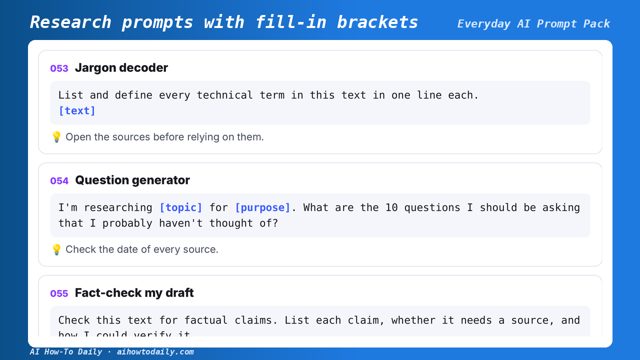
👀 Real pages from the PDF. Free 3-page sample (PDF, no email needed). The buy button opens Gumroad's secure checkout for “Everyday AI Prompt Pack: 122 Copy-Paste Prompts” ($7); the download link arrives right after you pay.
GivingTuesday is Tuesday, December 1, 2026, the Tuesday after Thanksgiving. Expect a wave of donation emails, texts and social posts that week, from charities you love and from people pretending to be them. AI is genuinely useful here for the thinking: what you care about, how much to give, what to ask, and which messages look off. It is not a reliable source for whether a specific charity is real or well run. Chatbots can make up ratings, tax ID numbers and addresses. So use AI to plan and question, and the official lookups below to verify.
Decide what you care about and how much to give
Help me plan my year-end giving.
Causes I care about: [e.g. local food bank, animal rescue, kids' literacy, disaster relief].
Total I can give this year: [$ amount]. Already given this year: [$ amount].
I prefer: [local / national / international], [one big gift / several small ones / a monthly gift].
Ask me up to 3 questions, then suggest a simple split of my budget across causes and explain the trade-offs.
Deciding the total first stops the GivingTuesday inbox from deciding it for you. A small monthly gift often helps a charity plan more than a one-off, so ask the AI to show both options.
Build a shortlist of questions, not a list of 'best charities'
Don't ask a chatbot to name the "best" or "most efficient" charity: it may present outdated or invented ratings with full confidence. Instead, name the charities you're already considering and ask it what to check:
I'm considering donating to: [charity names you found yourself].
For each one, give me a checklist of what to look up on official or independent sources before I give:
legal name, whether it's a registered charity, how it reports spending, recent news.
Do NOT state any rating, tax ID or financial figure yourself; tell me where to find it.Check the charity is real (5 minutes each)
- IRS Tax Exempt Organization Search (on IRS.gov): search the exact name or EIN and choose the "Pub. 78 Data" option to see whether the organization is eligible to receive tax-deductible contributions. Some eligible groups, such as many churches, may not appear separately, so a missing result isn't automatically a red flag.
- Independent reports: Charity Navigator, BBB Wise Giving Alliance (give.org), CharityWatch and Candid (GuideStar) publish reports on how many charities spend and govern. Coverage varies, so not every small or local group is rated.
- Search the name plus "complaint", "scam" or "fraud". Watch for look-alike names that sound like a well-known charity.
- Go direct: type the charity's web address yourself or use its official site, rather than tapping a link in an unexpected text or email.
Then paste what you found into the AI and ask for a plain summary, which is a job it's good at:
Here is what I found about [charity] from its website and [Charity Navigator / give.org / IRS search]:
[paste the text]
Summarise in 5 bullets: what it does, where the money goes according to these sources, anything that's missing or worrying,
and 3 questions I could email the charity. Only use the text I pasted.Run suspicious messages past AI before you give
The FTC's charity-fraud advice is blunt: scammers pressure you to give right away and ask for cash, gift cards, cryptocurrency or wire transfers. If someone asks you to pay that way, it's a scam. They may also claim you already pledged. AI is a decent second opinion on a message, as long as you remove your personal details first:
I received this donation request. I've removed my personal details.
[paste the text, email or post]
List any red flags (urgency, payment by gift card / wire / crypto / cash, claims I already pledged, a name that imitates a known charity,
links that don't match the charity's real website, refusal to share details). Then tell me how to verify it independently.
Don't tell me it's safe; just list what to check.
If it looks like a scam, don't reply or click. You can report it at ReportFraud.ftc.gov and to your state's charity regulator.
Give safely and keep the records
- Pay by credit card when you can. The FTC calls it the safest way to donate because it gives you some protection if something goes wrong. A check is the next best option.
- Crowdfunding and social posts: the money goes to whoever set up the campaign. The safest approach is giving only to people you know and trust. Gifts to individuals aren't tax-deductible.
- New for 2026 taxes (US): per the IRS, if you don't itemize, you may deduct up to $1,000 of qualifying cash contributions to eligible charities, or $2,000 for married couples filing jointly, on your 2026 return. Gifts to donor-advised funds and noncash gifts don't count toward it. Additional rules apply, so check IRS Publication 6196 or a tax professional. This isn't tax advice.
- Records: keep a bank record or receipt showing the charity's name, the date and the amount for every cash gift. For any single gift of $250 or more, you need a written acknowledgment from the charity before claiming it.
Make me a simple donation log I can paste into Google Sheets or Excel.
Columns: date, charity legal name, EIN (I'll fill this from the IRS search), amount, payment method, receipt received (Y/N),
written acknowledgment needed ($250+), notes.
Add a total row and a formula that flags any single gift of $250 or more without an acknowledgment.
Prefer a ready-made one? Download our free 2026 donation log (XLSX, no email needed; opens in Excel or Google Sheets). It totals your gifts, totals cash gifts, and highlights any $250+ gift still missing an acknowledgment.
Make the gift go further
Many employers match employee donations. It's worth a short email to HR to ask:
Write a short, friendly email to my HR team asking whether our company matches charitable donations,
what the limit and deadline are, and how to submit a match for a gift I made to [charity] on [date]. Under 100 words.
Giving time instead of money? Ask the AI for a list of questions to ask a local volunteer coordinator about shifts, training and age limits, then contact the organisation directly.
🔎 Why AI shouldn't be your only source
How to fact-check AI answers with primary sources.
💰 Fit your giving into one holiday budget
One season total, split into gifts, food, travel, tips and more, with max prices before Black Friday.
💌 Giving in someone's memory?
Write the condolence email that goes with a memorial gift.
Year-end letters, budgets and careful emails: 122 copy-paste prompts organized by task, ready to print or keep offline. One-time $7, 30-day refund.
Get the full pack for $7 →Frequently asked questions
When is GivingTuesday 2026?
Tuesday, December 1, 2026. It's always the Tuesday after US Thanksgiving, which falls on Thursday, Nov 26 this year.
Can ChatGPT tell me if a charity is legitimate?
Not reliably. Chatbots can state outdated or invented ratings and tax ID numbers. Use AI to plan, summarise and spot red flags, and verify the charity itself with the IRS Tax Exempt Organization Search and independent reviewers like Charity Navigator, give.org, CharityWatch or Candid.
What are signs of a charity scam?
Pressure to give right away, requests for cash, gift cards, cryptocurrency or wire transfers, claims that you already pledged, refusal to share details about how money is used, and names that imitate well-known charities. The FTC says a request to pay by gift card, wire or crypto means it's a scam.
Can I deduct donations if I take the standard deduction?
Starting with tax year 2026, the IRS says people who don't itemize may deduct up to $1,000 of qualifying cash contributions to eligible charities ($2,000 married filing jointly). Donor-advised funds and noncash gifts don't qualify, and other rules apply. Check IRS Publication 6196 or ask a tax professional.
What records do I need for a donation?
For any cash gift, a bank record or a receipt showing the charity's name, the date and the amount. For a single gift of $250 or more, a written acknowledgment from the charity. AI can build you a simple log to track it.
Quick tips on this topic
⚡ Charity red-flag check
Let AI scan a donation appeal for scam signs before you give.
⚡ Plan year-end giving
Decide the total before the GivingTuesday inbox decides for you.
🎁 Get all 159 copy-paste prompts free
Every prompt from our guides and tips on one page, for email, spreadsheets, meetings, automation and more. Fill in the brackets and paste.